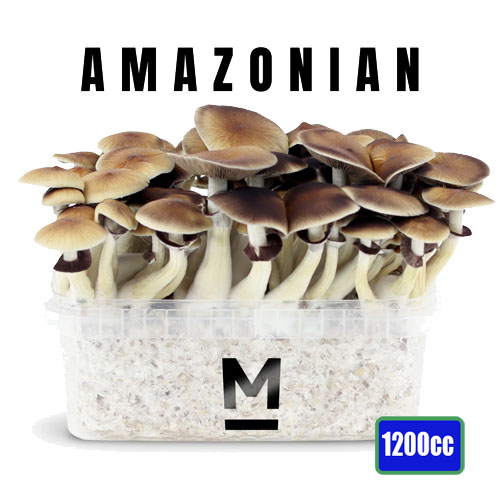
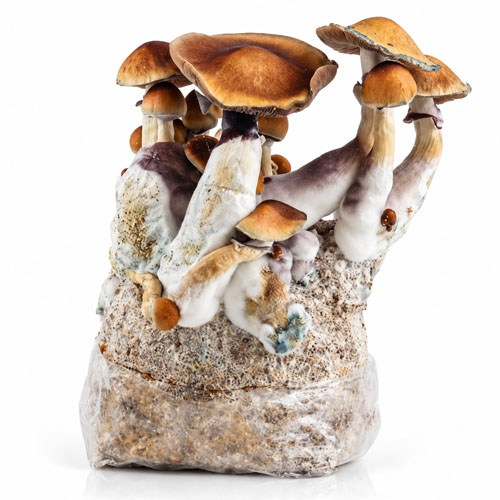
PES Amazonian is described as a large, fast mushroom: big golden caps with a pointed centre, quick colonisation and several flushes. Those descriptions come from the shop and from grower pages, and no study has measured them, so every trait below is labelled with where it comes from. The traits are useful as expectations for a kit. They are not specifications.
What the shop says
Dutch-Smart uses one strain text on the kit and the spore syringe: "This mushroom from the Amazon rainforest is very large and thick. It stands out due to its large, golden, nipple-shaped caps. This is one of the species recommended for beginner growers. The fruiting bodies of this Amazonian cubensis are very meaty. It colonizes quickly, and the mycelium is more rhizomorphic than average."
The spore ampoule adds that it is "one of the fastest-growing species, producing an enormous quantity of mushrooms up to 30 cm tall", and that it does well on brown rice flour cakes, grain and pasteurised or sterilised substrates. The grow bag text speaks of "strong colonisation and excellent fruiting potential" and "dense, well-formed fruiting bodies".
Rhizomorphic mycelium grows in thick, rope-like strands instead of an even fluffy mat. In a kit you see it as white cords running over the surface and along the sides of the box.
What growers reported
Two old, undated grower pages describe the PESA line in more detail. One, by growers who also fruited it outdoors in compost, reports:
- "very light caps, although large caps compared to small stems"
- a "semi-fast colonizer" that "fruits nicely in cold temps"
- that it "does tend to abort a lot", meaning many pins stop growing before they become mushrooms
- that it "does not utilize all of the substrate very well"
- second-flush caps of 5 to 6 inches (about 13 to 15 cm) across, and one mushroom 12 inches (about 30 cm) long
- that cut mushrooms "turn dark blue within 2-3 seconds", against 10 to 20 seconds for most cubensis in their experience
The other page calls it a line that "blues deeply". The blue colour is a reaction of psilocin with oxygen after damage, driven by two enzymes that a German team identified in P. cubensis (Lenz et al., 2020). How fast and how deeply a mushroom bruises is an observation, not a measurement of strength.
These are reports by a handful of growers with their own cultures and methods, on undated pages. They agree with the shop on size and speed. On "light caps" and "golden caps" they may simply describe different flushes or lighting.
Traits side by side
| Trait | Shop | Growers | What it means in a kit |
|---|---|---|---|
| Size | "very large and thick", up to 30 cm | caps 13 to 15 cm, one 30 cm specimen | leave room above the substrate; the filter bag must not press on the caps |
| Cap | golden, nipple-shaped | light, large compared to the stem | a pointed centre (umbo) is normal for this line |
| Colonisation | quick, rhizomorphic | semi-fast | the 1200cc kit and grow bag arrive already colonised |
| Pinning | not stated | aborts "a lot" | small dark, dried pins among healthy ones are not a sign of mould |
| Bruising | not stated | dark blue within seconds | blue patches where you touched are normal; green fuzzy patches are not |
| Flushes | "multiple flushes" | not stated | about three per kit says the manual; at most two per grow bag says Mondo |
Aborts, bruises and mould
Two of these traits can look alarming in a kit. Aborted pins stay small, turn dark at the cap and stop growing. Bruises turn blue where a mushroom was handled or pressed against the bag. Both are part of how cubensis grows. Mould looks different: the grow bag manual lists green, black, red and pink as colours of contamination, and white or yellowish-white as the colours of healthy mycelium. The kit forecast shows when in the cycle each is most likely.
What nobody has measured
No published study has compared PES Amazonian with other cultivars on colonisation time, yield or size. The yield on the kit's product page, 400 to 600 grams, is the shop's figure. Potency is unmeasured as well; the potency page explains what is known instead.
If you want to see the traits for yourself, the kit and the grow bag are the two ready-to-fruit options: