
PES Amazonian, often shortened to PESA, is a line of Psilocybe cubensis that takes its name from Pacific Exotic Spora, a spore supplier based in Hawaii, and from the Amazon, where it is said to have been found. The company name is documented on old grower pages. The Amazon collection is not: no published record says who collected it, where or when.
What PES stands for
PES is short for Pacific Exotic Spora, sometimes written Pacifica Exotica Spora. Old grower pages describe it as a company "out of Hawaii" that sold cubensis spores, and one of them calls PES Amazon "one of the original strains from the PES labs in Hawaii". The same company gave its name to a second line, PES Hawaiian. Spore sellers today describe PES as no longer trading; we found no company record that confirms when it started or stopped.
The Hawaii in the company name is a place of business. It says nothing about where the mushrooms came from. Dutch-Smart sells the other PES line as well, as a 1200cc kit and an XXL kit:
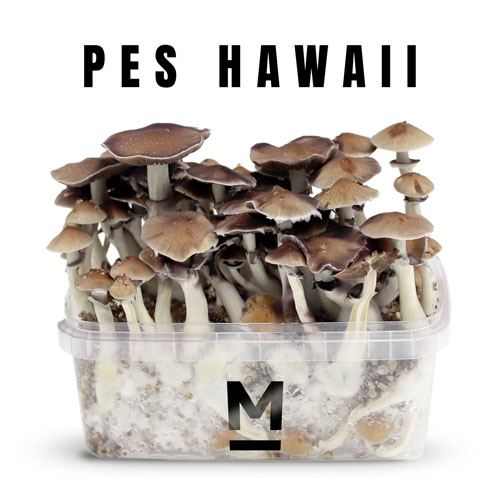 PES Hawaiian - 1200cc Mushroom Grow Kit
View at Dutch-Smart
PES Hawaiian XXL - 2100cc Mushroom Grow Kit
View at Dutch-Smart
PES Hawaiian - 1200cc Mushroom Grow Kit
View at Dutch-Smart
PES Hawaiian XXL - 2100cc Mushroom Grow Kit
View at Dutch-Smart
The hybrid story
One old grower page records that PES advertised the line as a cross between P. cubensis and Psilocybe azurescens, a wood-loving species from the north-west coast of the United States, and that the company linked it to the mycologist Paul Stamets. The author of that page rejected the claim: no hybrid of the two species had been published, and in his words the mushroom was "nothing more then a very potent cubensis".
We found no study, patent or publication by Stamets that describes such a cross. The two species grow on different substrates, cubensis on dung and azurescens on wood chips, and the PESA line grows on the same dung-based and grain substrates as any other cubensis. The hybrid story is best read as marketing from the time.
The Amazon in the name
Spore sellers repeat a story in which the line was found growing on a dung patty in the Peruvian Amazon and brought back to the PES lab. None of them names a collector, a place or a year, and none cites a source. Dutch-Smart's product texts say the mushroom comes "from the Amazon rainforest" and that the species "was discovered in the Amazon region". That is the shop's description; we could not trace it to a collection record either.
What is documented is that P. cubensis has been collected in the Peruvian Amazon. In a study published in 1982, Jeremy Bigwood and Michael Beug grew three cultures from a spore print taken near Pucallpa, Peru, one of them labelled "Amazon strain", and measured them in the laboratory (Bigwood and Beug, 1982, as tabulated in Kurzbaum et al., 2025). Whether that culture and the PESA line are related is unknown. The potency page covers what those cultures contained.
One name, several cultures
Cultivar names in cubensis have no register. A 2025 review of cubensis strains found that strain descriptions come mainly from community reports, and that cultures sold under one name by different suppliers often lack genetic similarity (Kurzbaum et al., 2025). One of the old grower pages adds that PESA "may also be known as Golden Teacher, Z, Creepers and/or Hawaiians", which shows how loosely the names were used.
| Claim | Status | Basis |
|---|---|---|
| PESA is a P. cubensis line | likely | grows and looks like cubensis; no published DNA test of a PESA culture |
| PES was a spore supplier in Hawaii | supported | old grower pages, seller histories |
| It was collected in the Amazon | unverified | seller and shop texts without a source |
| It is a cross with P. azurescens | unsupported | company advertising, rejected by growers; no publication |
| Every PESA sold today is the same culture | unknown | no comparison between suppliers published |
A name on a box tells you what the supplier says it is selling. For a grower, the more useful information is how the culture behaves, which the traits page collects, and how the shop's own kit is meant to be grown, which the kit forecast follows day by day.